 |
 |
|
|
 |
 Oct 6, 2015
Russian Language Survey Oct 6, 2015
Russian Language Survey
Is available online now. Dr. Ekaterina Levko of St. Petersburg State University and Dr. Gennady G. Knyazev of the Russian Academy of Medical Sciences helped in the Russian translation and will share the collected data for academic research.
Dec 13, 2012
Multilingual Surveys
Investigations of humor did not find conclusive links with personality. The main purpose of the new surveys is to add a new calculation to the investigations.
Oct 5, 2012
Finalist at AI Contest
The George and Mary software is a finalist at the British Computer Society's artificial intelligence contest, scheduled to take place in London on Oct. 5, 2012.
Jan 5, 2010
U.S. Patent #7,644,060
Its official. U.S. software patent covering Artificial Psychology Dialog Player with Age Simulation is granted today.
|
|
 |
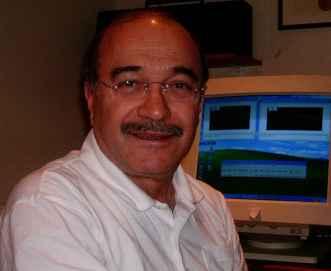 Currently, I work in the Montreal area for a hi-tech company which makes PC digitizers and "The world's most powerful oscilloscope software." My interest in Artificial Psychology is not work-related.
I started being interested in Psychology just after getting my PhD in Nonlinear Control Systems Engineering in 1974, I wanted to find problems where my newly found academic skills could be most useful. I chose to study live systems because they fitted the type of nonlinear mathematics better. I was fortunate in my first jobs, unrelated directly to the study of live systems but involved a deep understanding of electrical measurement and calibration, including the concepts of accuracy and reliability of measurements. These concept proved critical for me when I studied psychology and found many Factor Analysis results seem to support conflicting conclusions; the problem in my view was in the step leading to the analysis, the interpretation, not in the analysis itself. I believed that the process of interpretation should be treated like any other measurement process and must have well understood concepts of accuracy and reliability. My first self-published book in Egypt suggested that motivation and cognition are to interpretation like accuracy and reliability to a process of measurement, the multitude of cognitive personality models nearly all of which are supported by Factor Analysis are akin to reliability without accuracy in measurement. What was needed in my view is agreement over motivational interpretations. My approach was to build a model of human motivation based on animal behavior, so I started focusing on models of animal behavior. I found little agreement between animal psychologists except on identifying behavioral processes as either priming or homeostasis. Based on this distinction, I suggested a systems approach to modeling motivation in my second book titled "Animal Drives in Humans". Later on, the nonlinear systems mathematics of this approach was published in a joint paper with Ian Duncan of Guelph University in 1995. Since then and until now I focused my attention to implementing the motivational model as a PC based personality simulator.
I was born in Baghdad, Iraq in 1947. I went to kindergarten in Logan, Utah, U.S.A, where my father was researching for his PhD in Agriculture, then I went to school in Abu Ghraib, Iraq (yes the same location of the infamous prison but before Saddam expanded it). I finished high school in Baghdad then went to London, England to study engineering. I did my PhD in Systems Engineering at the University of Wales in Cardiff then started my first career job with Hewlett Packard in Europe, then I rep'd Fluke, Wavetek and other US companies in Egypt for 13 years. I emigrated to Canada in 1988. I am married and have one teenage daughter. Contact information are as follows: Best by email: faisal (at) artificialpsychology.com
Phone: 514 714 7877
Address: 40 Rosedale Avenue, Dollard Des Ormeaux, QC H9G 1E1, Canada
Privacy statement: I will not disclose your contact information to any third party without your express permission. |
|
|
|
 |
|
Home
TechNotes
About
FAQ
Products
Downloads
Contact
|
|
Copyright � 2005-2015 Faisal L. Kadri. All rights reserved.
|
|